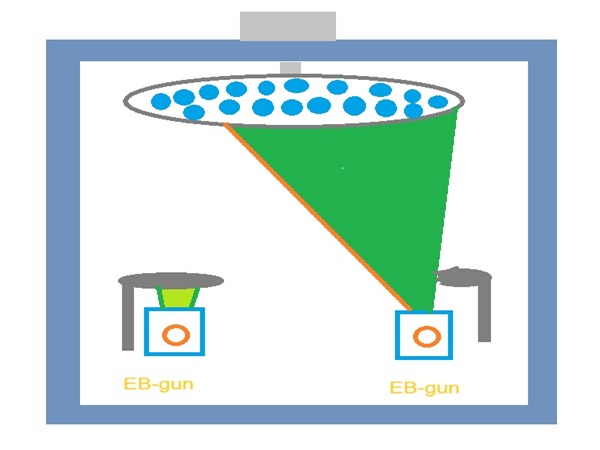
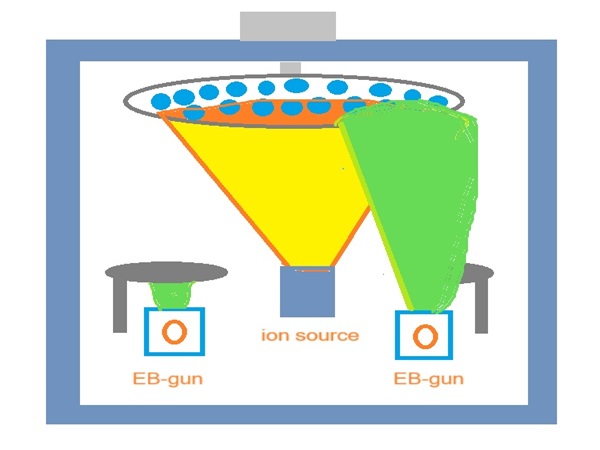
In the process of vacuum coating, the ion source (RF source, Hall source, Kaufman source, etc.) is used to clean the substrate before the start of coating, and the electron beam is used to evaporate the coating material to reach the substrate during the coating deposition process, and at the same time, the ions generated by the ion source are used to bombard the growing film, so as to improve the internal structure of the film and remove the water vapor adsorbed inside the film layer. Make the film denser and reduce wavelength drift; Reduces the internal stress of the membrane layer and reduces absorption through the binding of reactive gases.
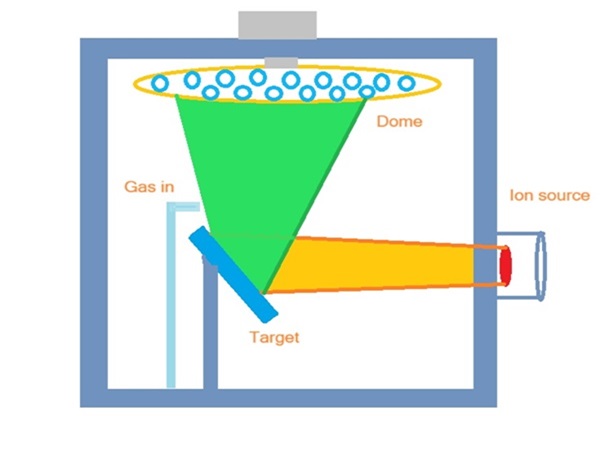
Ion beam sputtering (IBS) is a physical vapor deposition technique. The ions emitted by the ion source bombard the coating target, sputtering atoms or molecules on the target to form a thin film on the substrate. Compared with electron beam evaporation and ion-assisted deposition, the thin film formed by ion beam sputtering is denser and more structurally stable. Applied to the fabrication of high damage threshold laser component.
The principle of electron beam evaporation coating is to use the high-energy electron beam generated by the electron gun to heat the material, so that the coating material is liquefied and sublimated, and then deposited on the substrate surface to form a film. Compared with ion-assisted coatings and ion beam sputtering coatings, the structure of the electron beam evaporation coating is relatively loose and not dense, and the wavelength position is easily affected by environmental conditions and drifts. It is suitable for evaporating most oxides, fluorides, sulfides, and other coating materials.